

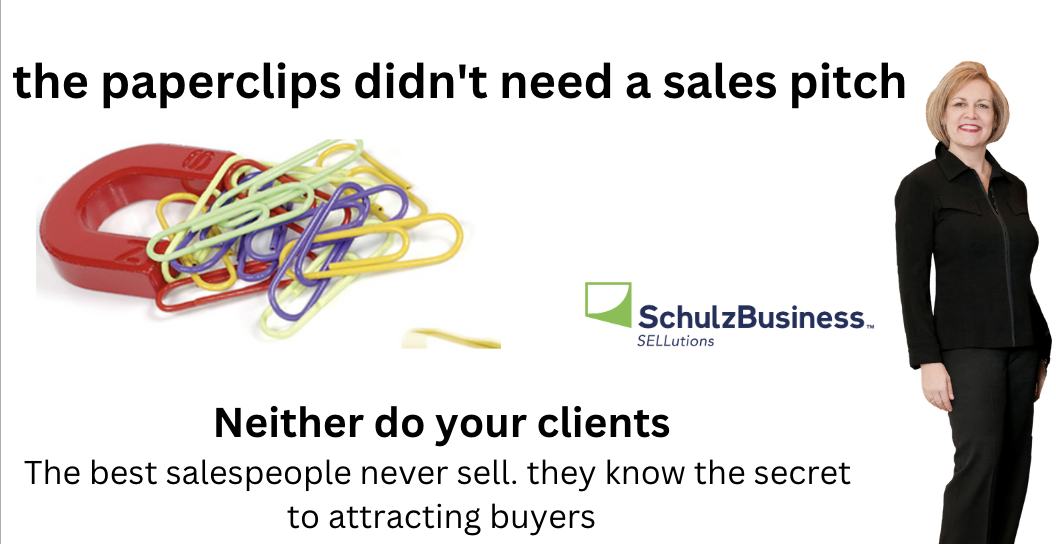

The paperclips didn't need a sales pitch. Neither do your clients.

SELLutions

The truth? Most people don’t know what makes a good salesperson.

by GSchulz 31. May 2013 06:28
Grant is a longtime client and a friend. He owns a small products company. He asked me to assess and interview “a friend of a friend” who he is considering for a sales job. I sent the assessment to Steve, and he completed it quickly. When I looked at it, he scored high is all of the areas that would make him good for a service job, but for the type of sales Grant – and, frankly, most sales organizations – needs, he was not a fit.I spoke to Grant about this, and he said: “Can you talk to him anyway? I think you’ll really like him.”That is probably the thing I hear the most from directors and CEOs alike: “But he’s a really good guy; just talk to him.”If I had a dollar for every time I heard that and the candidate was not a fit, I would be living on the beach, enjoying a margarita.I called Steve and spoke to him for quite a while. Actually he spoke to me – frankly, at me – for quite a while. Yes, Steve was certainly a nice guy, friendly, outgoing. He had the gift of gab, which is quite the opposite of what I look for in a sales professional.What I thought was funny: He said he took an online career survey that said he would be good at sales. He also explained that, when he asked people who knew him best, they all said he was a natural salesperson. That’s another quip I hear all of the time.The truth about sales is that most people have no idea what makes a good salesperson. The common belief is if you have a good personality, are outgoing and likable, you would be good at sales. Honestly, that is far from the truth. Years ago and in certain situations, this may have worked. For example, when the economy was rockin’ and you were selling a product that everyone needed anyway and prices were fairly consistent and it was just a matter of who to get it from, maybe this would work.Today, we need to be more skilled, more resourceful and much more consultative to persuade.Some things to look for when hiring;Preparation. Professional salespeople don’t just rely on a good personality to get the sale. They research the organization and develop good, thought-provoking questions to ask.Digging deeper. When professional salespeople get the answers to the questions they are asking, they don’t immediately flip into the selling mode. Top sales professionals take the answers to these questions and dig deeper for full understanding before they recommend anything.Always know the next step. Professionals know that the sale is nothing without having a clear next step. Not just a follow-up call, but a true understanding of what the next step is, and when it will occur.Toughness. Ultimately top sales professionals are tough. Yes, they can be friendly and outgoing, but more importantly: Can they stand their ground when the prospect throws them a curveball? Throw them a curveball and find out. I recommend saying something like: “I’ve interviewed several people that have the same experience as you. Why should I hire you over them?”It’s important to put prospective hires in a situation similar to one they will be in when selling. Put a little pressure on them. Don’t sell them on working for your company; make them sell you and see how they do. That is their job.Greta Schulz is a sales consultant for businesses and entrepreneurs. For more sales training tips and tools, or to ask her a question, go to www.schulzbusiness.com or emailgreta@schulzbusiness.com. Click here to share this post.

It's About the Process

by GSchulz 6. May 2013 04:52
  Ryan, a software sales rep, had been having a rough day. He’d been bombarded with questions from several customers and gotten behind on work he needed to finish before the end of the day. Then, he got a call from Wayne, a prospect who introduced himself by saying: “I’ve heard great things about your engineering software package. I saw a demo about a year ago, and was not in a position to purchase it at the time. But since then, it’s become very apparent that I need to integrate it into my system.” “Wow,” Ryan thought. “This will be easy. It’s about time something went right today.” Then, Wayne said: “I need to know about the cost, the tech support and how soon it can be installed.” Ryan immediately went into his pitch. He discussed tech support in detail, covered availability and other options, and explained that the price was $12,000, with 30-day terms. Wayne’s response was unexpected. He said that $12,000 was quite a hefty price tag and he needed a couple of days to think about all of this more carefully. He’d call Ryan back next week. Ryan did a double take. “What just happened?” he thought. “This sale was in the bag, a sure thing. He really needs it and now he’s thinking it over? He said he needed the software right away.” And that was the end of the call. So, what happened? Ryan got lazy, plain and simple. He thought Wayne was sold. All he had to do was give him the information he needed, then write it up. He got fooled into assuming the sale without doing the work. He never got Wayne to talk about why he was looking now, with what seemed to be a real priority about buying the software. The entire transaction was conducted at the intellectual level, without any real understanding of the true need. So, what happened? Ryan was lured into taking shortcuts. He mistakenly thought the prospect’s enthusiasm was as sure as a sale. No matter. You need the time to qualify the prospect and make sure he’s real before giving out information or making your presentation. In Ryan’s case, a couple of questions would have made a world of difference. He might have said: “Before we discuss pricing, help me understand why this software is so important. I want to make sure the application is correct for you. Would you mind if I ask you a couple of questions?” Of course, you’re digging in to find out what is really going on. It is so important to gather this information before you discuss price so you can truly have an understanding of not only why they want the software, but the consequence of not installing it. Once you give away your information – whether on the phone, in a presentation or in the form of a proposal – you have given up any form of control and are literally at the mercy of the prospect. Remember: It’s not about the sale; it’s about the process. Click here to share this post.

Are You Tiger Woods?

by GSchulz 15. April 2013 06:37
  Should I hire a coach? I mean, I have been in business for a long time and I do go to a lot of seminars. I feel like of I can learn one thing each time I go. That’s good, right?” my ridiculously fit client, Darlene, asked me. So, to help her understand if she should hire a coach or not, I tried to help her through what she does. I answered: “Darlene, I don’t know if you should hire a coach, but let me ask you a couple of questions. I know you work out, we’ve talked about that before. And I know you go to the gym.” “Yes, of course,” she said. “Do you have a coach?” I asked. “Well, yes, I have had one for a couple of years.” “OK, so why do you have a coach? You know how to work out.” She told me that the coach taught her exactly how to do things the right way on each piece of equipment. She also kept her accountable. She was with her every step of the way and pushed her when she got tired and didn’t want to go any further. So I said: “Well, let me ask you something, Darlene: Say you hired a coach for one day, you were new to working out and you went to the gym with this coach. The coach walked you around to each piece of equipment, showed you exactly how to use the equipment, told you how many repetitions you should do on each piece of equipment and how to use it for the best result – and then you never hired that coach again. How long you think it would take you to achieve what you have now achieved?” She laughed and said: “OK, I get it.” As we had this discussion and laid it out, she began to understand the reason you need a coach in other parts of your life, whether it’s business or, more specifically, sales. People often tell me they are a people person and it’s all about relationships, so with their personality alone, that will work. Good luck. So, what are the things that you gain from a coach? No. 1, it’s setting up the right activities that you should be doing on a regular – daily, weekly, monthly – basis, whether it’s a business coach, a sales coach or a fitness coach. They set up the right activities for you. No. 2, they set you up with accountability, where they work you through these activities or you need to report back that you’ve done them and discuss how. No. 3, a coach keeps you doing it properly by constantly reinforcing what you’re doing, making slight changes so you do it right, and knowing when and how to bring you to the next level for maximum results. There are an awful lot of reasons why each person decides to hire a coach. But I find it interesting when I talk to people in sales who say: “Well, I know it’s a good idea to get a coach at the beginning. But I’ve been in sales for a lot of years and I don’t need a coach. I know how to do it.” My answer to those people is: “Who’s the best golfer in the world?” and Tiger Woods is what they always answer. I say: “OK, Tiger Woods, the best in the world – in the world of golf – has five coaches. He has a swing coach. He has a pitching coach. He has a putting coach. He has a fitness coach. He has lots of different coaches. So if you can tell me that you’re better at your business than Tiger Woods is at golf, then you’re right. You don’t need a coach.” Until you can say that, sign up. Greta Schulz is a sales consultant for businesses and entrepreneurs. For more sales training tips and tools, or to ask her a question, go to www.schulzbusiness.com or email greta@schulzbusiness.com. Your  Click here to share this post.

Is it Easier to Sell a Product or a Service?

by GSchulz 29. June 2012 08:30
Is it easier to sell a product or service? “It’s easier to sell a product because you have something you can actually show the prospect”. “Oh no, it’s much easier to sell a service because you can really sell them on the features and benefits!”.   Guess what, you’re both wrong! You are never selling a product or a service, you are only selling what the product or service can do for your prospect. The solution your customer perceives is the problem to the problem they are experiencing is the only one that matters. What your product or service does is irrelevant, until the prospect tells you what actually is relevant.   We have a friend named Rich. Rich and I had a discussion one night at dinner on this very subject. Rich told me he could ‘never’ (and I love that word) sell a service because a product is so much easier. “Why is that?” I asked. “It’s just easier to compare when you have something in your hands. You can show your products ‘features and benefits’, (another of my favorite terms) and really compare apples to apples against your competitor” Rich stated proudly “Rich, how do you know what ‘apples’ they want in the first place? What if they want oranges? “Oh I ask them up front what their needs are and then I show the differences”. “So, I’m confused, why can’t you do that with a service?” “Well Greta I guess you can but it’s easier with a service”... “OK Rich, I got it” even though I didn’t but at this point, my husband was kicking me under the table to leave it alone.   In sales you are a matchmaker of sorts. Your job is to uncover as much about the prospects issues as they see them and the effect these issues are having on them and their company. Additionally if nothing changes, what are the re-percussions of that? Once you have a good understanding of what that is, you will recommend the proper solution, irrespective of the product or service. Often salespeople misunderstand the word “benefits” for solutions. Feature and benefits selling is typically is a pre-set dissertation of what the prospect should see as a benefit, not what they decide is a benefit. For example if you say “the feature of this copy-machine is the speed of the copies and the benefit is you can get them faster and have your copies ready earlier”. Well, if you don’t have an issue with time and you issue is something completely different like ease of use, who really cares about your “benefit”? If you are selling properly, it shouldn’t matter whether it is a product or a service because what you are really selling is what the client is ultimately looking for, not how you get there. Anyone can “demo” a product or talk “features and benefits” but a real pro only gives solutions to the issues the prospect is talking about, no more and no less.   Click here to share this post.

Give it a Try

by GSchulz 17. June 2012 13:40
Have you ever tried to pick up a pencil? Have you ever tried to take a drink of water? No you haven’t.  You just do it. Lack of commitment is the failure of most salespeople, and even their clients. “I tried” is the lamest excuse I have ever heard. I’d like to share an example that illustrates this point, using the example of advertising.   There are approximately 120,000 salespeople selling some form of advertising in America.  Each of those sales people will make “prospecting calls” to an average of three business owners per day. One business owner out of 12 will say, “Well, maybe it does make sense for my business. I’ll go ahead and buy a small schedule and ‘give it a try.’ And if it works, I’ll use your station/ paper product/ (fill in the blank) on a regular basis.”   Sounds pretty good, right?   This is perhaps the dumbest thing I have ever heard. Let me share a similar example with you to prove my point. Let’s say you are in Vegas standing at the roulette table and you think, “I’m going to place a small bet on black and if I win, I’ll start betting on black on a regular basis.”  Sounds a little ridiculous, don’t you think?   There are thousands of business owners who will be making a decision to “give it a try” today. Most of them will experience poor results. Will they be disappointed? Yes. Surprised? No. They will not be surprised because they have “given it a try” before, with very limited success.   Why would business owners do what they have done before and expect different results? Because bad salespeople have taught them to do this. Not every product or service works this way. But if you’ve ever heard the old adage “over promise and under deliver,” it gives the same result.   “I’ll give it a try” or “let me test the waters” is the signature of an uncommitted customer. I think we would be hard pressed to find these customers experiencing a high degree of reward from their efforts…because there is none. With risk comes reward. Show me a committed and focused client, and I will show you success in the making.  
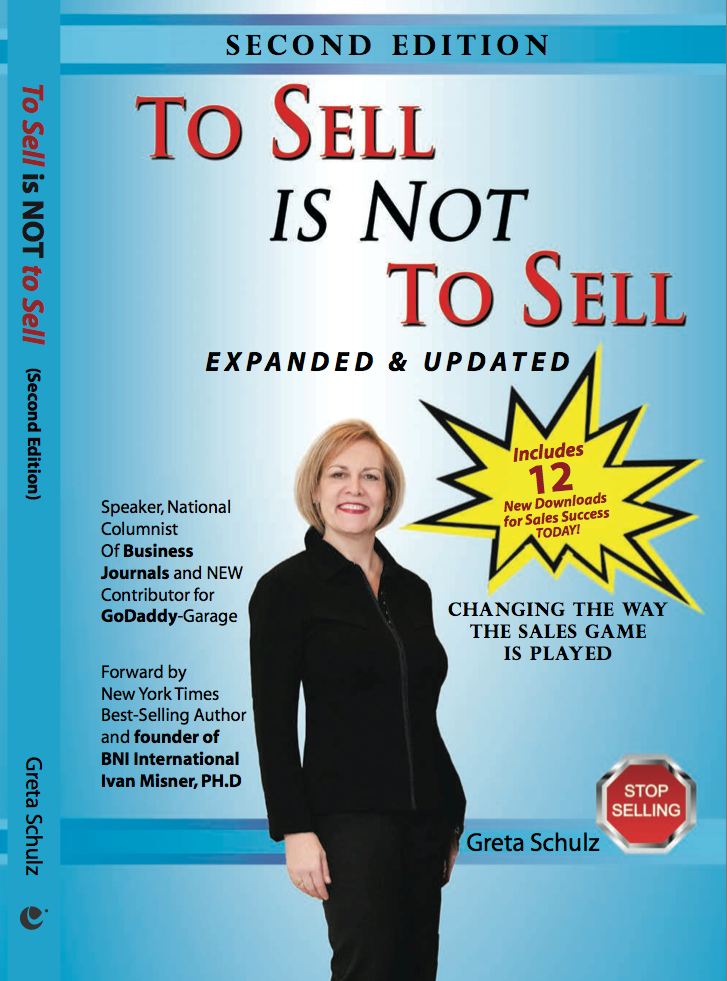
 Greta Schulz is president of Schulz Business SELLutions in West Palm Beach, Florida. She is the best selling author of "To Sell is Not to Sell". Greta does corporate training for fortune 1000 companies and she has an on-line training course for entrepreneurs. For more tips go to: www.schulzbusiness.com click on Caffeine   Click here to share this post.

Tag cloud