



The paperclips didn't need a sales pitch. Neither do your clients.

SELLutions

It's About the Process

by GSchulz 6. May 2013 04:52
  Ryan, a software sales rep, had been having a rough day. He’d been bombarded with questions from several customers and gotten behind on work he needed to finish before the end of the day. Then, he got a call from Wayne, a prospect who introduced himself by saying: “I’ve heard great things about your engineering software package. I saw a demo about a year ago, and was not in a position to purchase it at the time. But since then, it’s become very apparent that I need to integrate it into my system.” “Wow,” Ryan thought. “This will be easy. It’s about time something went right today.” Then, Wayne said: “I need to know about the cost, the tech support and how soon it can be installed.” Ryan immediately went into his pitch. He discussed tech support in detail, covered availability and other options, and explained that the price was $12,000, with 30-day terms. Wayne’s response was unexpected. He said that $12,000 was quite a hefty price tag and he needed a couple of days to think about all of this more carefully. He’d call Ryan back next week. Ryan did a double take. “What just happened?” he thought. “This sale was in the bag, a sure thing. He really needs it and now he’s thinking it over? He said he needed the software right away.” And that was the end of the call. So, what happened? Ryan got lazy, plain and simple. He thought Wayne was sold. All he had to do was give him the information he needed, then write it up. He got fooled into assuming the sale without doing the work. He never got Wayne to talk about why he was looking now, with what seemed to be a real priority about buying the software. The entire transaction was conducted at the intellectual level, without any real understanding of the true need. So, what happened? Ryan was lured into taking shortcuts. He mistakenly thought the prospect’s enthusiasm was as sure as a sale. No matter. You need the time to qualify the prospect and make sure he’s real before giving out information or making your presentation. In Ryan’s case, a couple of questions would have made a world of difference. He might have said: “Before we discuss pricing, help me understand why this software is so important. I want to make sure the application is correct for you. Would you mind if I ask you a couple of questions?” Of course, you’re digging in to find out what is really going on. It is so important to gather this information before you discuss price so you can truly have an understanding of not only why they want the software, but the consequence of not installing it. Once you give away your information – whether on the phone, in a presentation or in the form of a proposal – you have given up any form of control and are literally at the mercy of the prospect. Remember: It’s not about the sale; it’s about the process. Click here to share this post.

Is it Easier to Sell a Product or a Service?

by GSchulz 29. June 2012 08:30
Is it easier to sell a product or service? “It’s easier to sell a product because you have something you can actually show the prospect”. “Oh no, it’s much easier to sell a service because you can really sell them on the features and benefits!”.   Guess what, you’re both wrong! You are never selling a product or a service, you are only selling what the product or service can do for your prospect. The solution your customer perceives is the problem to the problem they are experiencing is the only one that matters. What your product or service does is irrelevant, until the prospect tells you what actually is relevant.   We have a friend named Rich. Rich and I had a discussion one night at dinner on this very subject. Rich told me he could ‘never’ (and I love that word) sell a service because a product is so much easier. “Why is that?” I asked. “It’s just easier to compare when you have something in your hands. You can show your products ‘features and benefits’, (another of my favorite terms) and really compare apples to apples against your competitor” Rich stated proudly “Rich, how do you know what ‘apples’ they want in the first place? What if they want oranges? “Oh I ask them up front what their needs are and then I show the differences”. “So, I’m confused, why can’t you do that with a service?” “Well Greta I guess you can but it’s easier with a service”... “OK Rich, I got it” even though I didn’t but at this point, my husband was kicking me under the table to leave it alone.   In sales you are a matchmaker of sorts. Your job is to uncover as much about the prospects issues as they see them and the effect these issues are having on them and their company. Additionally if nothing changes, what are the re-percussions of that? Once you have a good understanding of what that is, you will recommend the proper solution, irrespective of the product or service. Often salespeople misunderstand the word “benefits” for solutions. Feature and benefits selling is typically is a pre-set dissertation of what the prospect should see as a benefit, not what they decide is a benefit. For example if you say “the feature of this copy-machine is the speed of the copies and the benefit is you can get them faster and have your copies ready earlier”. Well, if you don’t have an issue with time and you issue is something completely different like ease of use, who really cares about your “benefit”? If you are selling properly, it shouldn’t matter whether it is a product or a service because what you are really selling is what the client is ultimately looking for, not how you get there. Anyone can “demo” a product or talk “features and benefits” but a real pro only gives solutions to the issues the prospect is talking about, no more and no less.   Click here to share this post.

SELL NAKED!

by GSchulz 31. May 2012 11:14
You know the picture all too well. You agree to see a salesperson in your office. Weather you asked to see them or they called on you, you have reluctantly agreed to the appointment.   So on the scheduled time and date, in walks the salesperson. How do you know it’s them? Oh, there is no mistaking it! A briefcase in one hand, a portfolio in the other and something you can’t seem to figure out is under their arm.   You close your eyes because you just know what you’re in for. Some big dog and pony show of all the latest and greatest that they have to show you. Ahhhh!!   Why do you despise this so much? The whole time you are thinking, can’t you just get to the bottom line?! You hate it because you may be interested in some parts of their product/service but you really just want to know how it can help you. You probably don’t even need to know that it slices and dices too….or do you?   Certainly the salesperson believes that if they show you all of the “features & benefits” you will find something that you like and that will convince you to buy it. Why does it feel like so much work for you when it’s their job? Or is that just their job, to show you all the stuff? No! They should figure out exactly what it is you need and then show you only that.   How? Sell Naked!   What? Yes, they need to sell naked. That means during the initial visit nothing should happen other than a conversation. They should not bring you any brochures or product samples, no, nothing. Simply a conversation between you and them to see if what you need fits what they have. Selling Naked means to go into a sales call with nothing but a pen and a pad. Your ears are helpful here but that’s it. Why? Because it takes a good, deep investigative dialog to figure out what a prospects needs are. If at that time there may be a fit, fine go get your clothes…or your product. But not until then. So go ahead, try it. Sell Naked. You will be surprised at the reaction!     Click here to share this post.

The Take-Away

by GSchulz 27. March 2012 10:34
“I really can’t say that what you’ve shown me, Bob, does anything for me,” stated the prospect.

“In fact,” he went on, “your choice of colors is nowhere as extensive as your competitor’s, who was just in here this morning, by the way.”

Bob hated this type of prospect. And for some reason, the past five months had been filled with them. Gosh, thought Bob, this is going to be one of those meetings where he raises the hundred objections and I try to beat them down one after another.  There’s got to be a better way to make a living. “I didn’t know you were looking at anyone else,” responded Bob.

“Well, it’s what I should do. And I’ll tell you this now, right upfront, her prices are extremely favorable.  I doubt you could beat them.”

Here goes, thought Bob, start knocking them down. “Let’s talk about the colors; our colors are by far the…” Two hours later, Bob crawled out of the office with a signed purchase order. Totally exhausted, he got into his car, called the office and read them the order.

“Good work,” the sales manager responded, “but how come he’s ordering less than before?”

“The competition has got a proposal on the table,” responded Bob, “you wouldn’t believe what I had to do to get what we did.”  With a felling of dread he added, “I’m going back next week to see if I can knock them out.”

Bob was so afraid that he was going to lose the client that he was prepared to do just about anything to keep him. Bob had the guts to spend another two hours butting heads, but he did not have the guts to find out if he really needed to do this.

Taking a sale away, taking yourself out of the running, and then waiting for a response from the prospect/customer takes real guts. This is not a technique for those with weak knees. No one can fault Bob for his dedication to task. And most salespeople and sales managers would agree that in the above story, which happens every day, there was nothing else to do but “gut it out.” But there is something else.

Before Bob launched into meeting every objection, he could have done something very simple. He could have said, “You might not realize what you are telling me; I want to make sure that I have it right. The competition has more colors, the price is good, they were here this morning, I guess it’s over for me. When you gave the order to the salesperson this morning, was she excited?” And then wait for a response from the prospect, no matter how long it takes. In order for this technique to work, your really have to mean it and be prepared to “walk out the door” and not look back. If you cannot do this, this technique will blow up in your face. However, if you are truly prepared to walk away, this technique is incredibly powerful at eliminating objections. There are a multitude of words and gestures that you can use to “take it away” depending on what you are trying to accomplish and with whom.

Customers and prospects alike are famous for stating, in so many words, that the other guy can do better for less. In essence, you want to mirror back to them what they just told you and then state, not ask, “You did place the order.” Then do not speak until you get a response. Either the order has been placed or not. If is has, it probably really is over for you. If it hasn’t, then you deserve to know the reasons why. And when you find out why? You are now learning what you need to do to get the order or keep the order.

Prospects who gave given all the indications of being ready to buy, but who just resist closing, are especially susceptible to having it taken away. “Bill, you have given every indication that you are ready to buy. But for some reason you just aren’t sharing, you keep stopping short. I think I should leave.” Then wait for a response.

MORAL: Take it away ONLY if you are prepared to walk out the door. Once you take it away, wait for a response regardless of how long it takes.

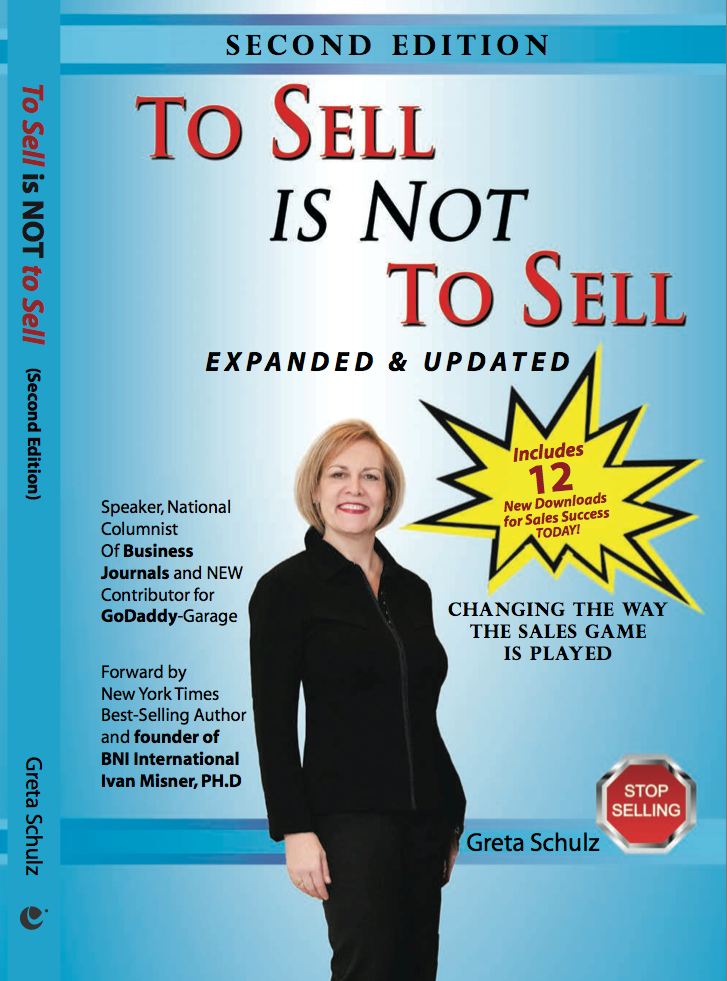
Greta Schulz is president of Schulz Business SELLutions in West Palm Beach, FL. She is the author of "To Sell is Not to Sell" and a columnist for business journals around the country. Greta does corporate training for Fortune 1000 companies and she has an on-line training course for entrepreneurs.

Click here to share this post.

You make it happen, in sports and in sales

by GSchulz 12. March 2012 07:40
While watching football with my husband a story came on during halftime about a college football player. I can’t remember his name, but he was a Boston College hero. A few years ago, he was a shining star. He was the one who, many said, was going to not only play professionally but also be drafted in the first round. All of a sudden, in his third year of playing, he had some pain in his legs. His family took him to the doctor. Well, he had cancer. He had bone cancer, and it had hit one of his legs. They were devastated.

After a short gasp, he asked the doctor “What we can do?” The doctor explained that they were going to put a metal rod in his leg and, after all of that, a long bout with rehab. He asked “When will I be able to go back to football?”

The doctor said “You will probably never play football again."

“No, no, you don’t understand," the player said, "I’m playing football. That’s my life. It’s just a matter of when I can get back to doing it, not if.”

What I really liked about this story is life is all about choice.

I recently did some shopping with my daughter. At lunch, we were talking about her brother. If you follow my column, you know that, about a year ago, a shark bit our son, and basically the same thing happened. After five hours of surgery and 400 stitches, he asked the doctor “When I will be able to get back to baseball?"

The doctor said “Don’t worry about baseball; just make sure your foot is OK.”

My son said “No, no. I will be playing baseball. When will I be able to get back?”After six months of rehab and after dropping a 10-pound weight on his finger and six weeks of healing from that, almost exactly one year to the day after his shark bite, he was signed by the Kansas City Royals’ minor league baseball team.


At lunch, our daughter said to me “Someday, if Clayton makes it to the big leagues--”

I stopped her, “Jessie, it has nothing to do with if, it has to do with when. If Clayton chooses to go to the big leagues, and he does what he does now, which is work harder than everybody else, longer than everybody else, and puts more in than everybody else, he will be in the big leagues.”

After looking at me with her eyes squinted like she was pondering that comment deeply, she said “But what about the other great players, and what if they don’t choose him?” I shook my head and said with 100 percent confidence that if he decides to be in the big leagues, he’ll do it. Choosing your path, the things that you do in your life, are a choice. They’re your choice. For some reason, we all forget that and let others decide.

Clayton may have to fight harder, look for a different path than the one he was originally on, but it is a choice that he will make: To have his life the way he wants it. If Clayton decides that he wants to continue on this path and he wants to play on TV in the major leagues, he’s going to. Nothing will get in his way. If somebody is chosen ahead of him, he will just work harder and go out there to be chosen next. If it takes him longer than he thought, then he will just work harder until he gets there. If a coach, a player, anybody gets in his way, he’ll just work around them.

When you make a choice to do something in your life, you do it. You may not know the time frame and you may not know the exact circumstances, but either way, you follow your choice. I said “Jessie, Clayton will be in the major leagues because he’s decided and made a decision that’s what he wants.”

She looked at me and said “You know, I think that makes sense.”

What’s important for all of us to remember is that we have to decide what our fate is. Our fate has very little, if anything, to do with people and circumstances around us, who we work for, the economic situation or anything else. Those are obstacles that get in our way, and our job is to work over, under, around or through them. They only get in our way if we let them. If something is in your way, remember it’s just a hurdle and you have to jump over it. The question is: How high are you willing to jump?

Greta Schulz is president of Schulz Business SELLutions in West Palm Beach, FL. She is the author of "To Sell is Not to Sell" and a columnist for business journals around the country. Greta does corporate training for Fortune 1000 companies and she has an on-line training course for entrepreneurs.

Click here to share this post.

Tag cloud