

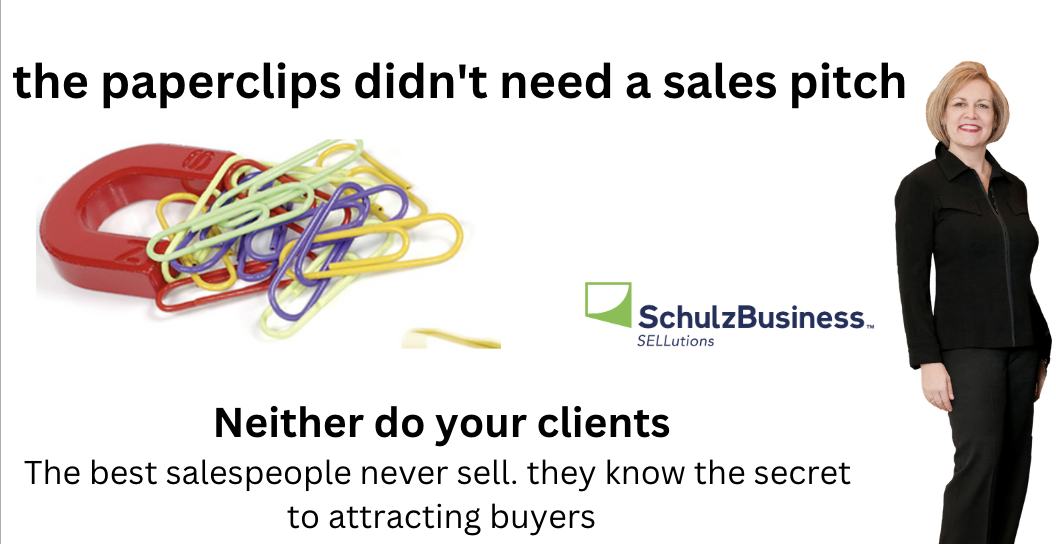

The paperclips didn't need a sales pitch. Neither do your clients.

SELLutions

The truth? Most people don’t know what makes a good salesperson.

by GSchulz 31. May 2013 06:28
Grant is a longtime client and a friend. He owns a small products company. He asked me to assess and interview “a friend of a friend” who he is considering for a sales job. I sent the assessment to Steve, and he completed it quickly. When I looked at it, he scored high is all of the areas that would make him good for a service job, but for the type of sales Grant – and, frankly, most sales organizations – needs, he was not a fit.I spoke to Grant about this, and he said: “Can you talk to him anyway? I think you’ll really like him.”That is probably the thing I hear the most from directors and CEOs alike: “But he’s a really good guy; just talk to him.”If I had a dollar for every time I heard that and the candidate was not a fit, I would be living on the beach, enjoying a margarita.I called Steve and spoke to him for quite a while. Actually he spoke to me – frankly, at me – for quite a while. Yes, Steve was certainly a nice guy, friendly, outgoing. He had the gift of gab, which is quite the opposite of what I look for in a sales professional.What I thought was funny: He said he took an online career survey that said he would be good at sales. He also explained that, when he asked people who knew him best, they all said he was a natural salesperson. That’s another quip I hear all of the time.The truth about sales is that most people have no idea what makes a good salesperson. The common belief is if you have a good personality, are outgoing and likable, you would be good at sales. Honestly, that is far from the truth. Years ago and in certain situations, this may have worked. For example, when the economy was rockin’ and you were selling a product that everyone needed anyway and prices were fairly consistent and it was just a matter of who to get it from, maybe this would work.Today, we need to be more skilled, more resourceful and much more consultative to persuade.Some things to look for when hiring;Preparation. Professional salespeople don’t just rely on a good personality to get the sale. They research the organization and develop good, thought-provoking questions to ask.Digging deeper. When professional salespeople get the answers to the questions they are asking, they don’t immediately flip into the selling mode. Top sales professionals take the answers to these questions and dig deeper for full understanding before they recommend anything.Always know the next step. Professionals know that the sale is nothing without having a clear next step. Not just a follow-up call, but a true understanding of what the next step is, and when it will occur.Toughness. Ultimately top sales professionals are tough. Yes, they can be friendly and outgoing, but more importantly: Can they stand their ground when the prospect throws them a curveball? Throw them a curveball and find out. I recommend saying something like: “I’ve interviewed several people that have the same experience as you. Why should I hire you over them?”It’s important to put prospective hires in a situation similar to one they will be in when selling. Put a little pressure on them. Don’t sell them on working for your company; make them sell you and see how they do. That is their job.Greta Schulz is a sales consultant for businesses and entrepreneurs. For more sales training tips and tools, or to ask her a question, go to www.schulzbusiness.com or emailgreta@schulzbusiness.com. Click here to share this post.

Selling Me A Car

by GSchulz 29. April 2012 07:27

I’m always trying to illustrate how professional sales really works -- helping your prospect self-realize that he or she needs (or in some cases, doesn’t need) your product or service. One of the best examples I’ve ever seen is one that happened to me when I decided to purchase a new Jeep.

Several years ago, I married a wonderful man who had two children. I also had a child of my own, so we were going to need a more “Brady-esque” car. After a lot of research, we decided that a Jeep Cherokee would do the trick. At that time, A Cherokee Laredo, the base model, would cost $299 a month to lease for three years with $1,000 down. A good deal for us by all accounts.

Since I know how car dealers work (or so I thought), I felt very strongly about staying emotionally detached and just purchasing the car for the price I wanted. I called the local Jeep dealership and asked for the sales manager. Richard (who I believe is still there) answered the phone. I explained to him that I wanted a Jeep Cherokee Laredo, dark green in color, and that I’d be willing to buy it today if he could match the price I wanted: $299 for a 36 month lease plus $1,000 down.

I was strong in my demand, making sure he knew I was in charge. Richard said he could match the price, but the only Cherokee Laredo he had on the lot was army green, not the dark green I wanted. Even though I was disappointed (the dark green is so much more “me”), I decided it was the route to go.

We arrived at the dealership, and I commanded my fiancée and the kids to stay in the car. “Wait here,” I said. “I’ll handle this.”

I walked into the showroom, where Richard greeted me. “You must be Greta,” he said with a sincere-looking smile.

“I am, “ I answered cautiously.

He smiled. “OK. Let’s go drive the car.”

I stopped him. “Oh no,” I exclaimed. “I want to talk money first!”

“Okay,” Richard replied. “But didn’t you say $299 for three years with $1,000 down? Since that’s what we agreed to, that’s what it is, right?”

With a half-smile on my face, I nodded proudly. “Right!”

As we walked through the lot to the army green (more of a pea green, actually) Jeep, Richard asked which car in the parking lot was mine. I pointed to the blue BMW where my fiancée and our kids waited. As we got into the Jeep, Richard made an interesting comment. “This car doesn’t have a leather interior,” he said. “It’s cloth, but that shouldn’t be a problem. I’m sure your kids don’t spill things at their age.”

“No, that’s OK,” I quickly replied.

As we pulled out of the dealership for the test drive, Richard played with the radio, then asked what kind of music I liked.

“Oh gosh, jazz. Top 40. Lot’s of different things.”

“Really?” he replied. “Do you have a lot of CDs?”

“Oh yes!” I proudly proclaimed. 

“Hmmm,” he mused. “You know this car doesn’t have a CD player, but I’m sure you’ve got cassettes.”

“Or I’ll just play the radio,” I said, not without reservation.

He smiled. “Of course you can,” he replied confidently.

As we pulled back into the dealership lot, Richard asked “So, what do you think?”

“Pretty nice,” I hesitantly replied. “It drives more like a truck, but hey, it’s not a BMW and you have to give up something, right?”

Silent, I walked into the showroom to go sign the papers.

“Hey Greta,” I heard Richard suddenly say. “That emerald green on that car down at the end of the lot…was that the color you originally asked me for?”

I felt sudden excitement. “Yes! But I thought you didn’t have one.”

“Not for a Laredo. But that’s a Grand Cherokee. It’s got all the bells and whistles, you know…CD player, leather seats and a smoother drive train. But that’s not the one you said you wanted.”

I couldn’t resist. “Ummmmm … how much more is it?”

Guess which one I drove away in (and only paid $70 more a month more for)? You got it!

And guess what I said to my fiancée when we were walking toward our new Grand Cherokee? “Honey, it’s more expensive, but I’m in sales. My car is like my office. I have to be comfortable.”

So what happened? Well, Richard did a really good job of finding out what was important to me. But he never told me those things were important. Instead, he asked the right questions that got me to self-realize that I wanted those things.

And what did I do? I made an emotional decision and justified it intellectually to my family. Remember, people love to buy, but they absolutely hate to be sold. So help them buy and stop selling them. It even worked on me, and I saw it coming.

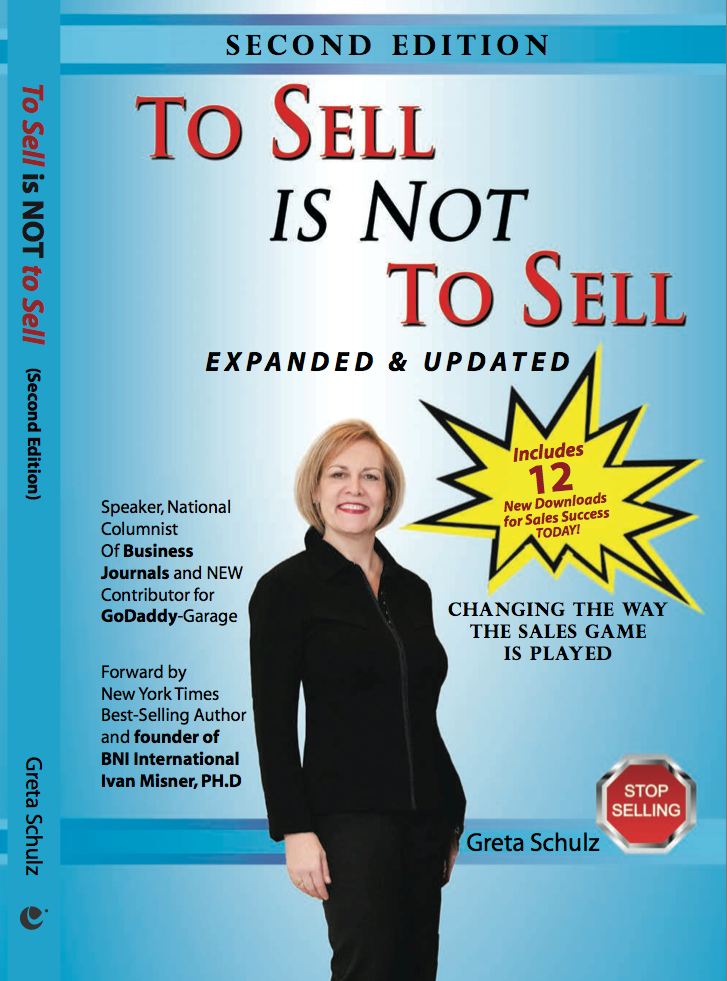
Greta Schulz is president of Schulz Business SELLutions in West Palm Beach, FL. She is the author of "To Sell is Not to Sell" and a columnist for business journals around the country. Greta does corporate training for Fortune 1000 companies and she has an on-line training course for entrepreneurs.

Click here to share this post.

You make it happen, in sports and in sales

by GSchulz 12. March 2012 07:40
While watching football with my husband a story came on during halftime about a college football player. I can’t remember his name, but he was a Boston College hero. A few years ago, he was a shining star. He was the one who, many said, was going to not only play professionally but also be drafted in the first round. All of a sudden, in his third year of playing, he had some pain in his legs. His family took him to the doctor. Well, he had cancer. He had bone cancer, and it had hit one of his legs. They were devastated.

After a short gasp, he asked the doctor “What we can do?” The doctor explained that they were going to put a metal rod in his leg and, after all of that, a long bout with rehab. He asked “When will I be able to go back to football?”

The doctor said “You will probably never play football again."

“No, no, you don’t understand," the player said, "I’m playing football. That’s my life. It’s just a matter of when I can get back to doing it, not if.”

What I really liked about this story is life is all about choice.

I recently did some shopping with my daughter. At lunch, we were talking about her brother. If you follow my column, you know that, about a year ago, a shark bit our son, and basically the same thing happened. After five hours of surgery and 400 stitches, he asked the doctor “When I will be able to get back to baseball?"

The doctor said “Don’t worry about baseball; just make sure your foot is OK.”

My son said “No, no. I will be playing baseball. When will I be able to get back?”After six months of rehab and after dropping a 10-pound weight on his finger and six weeks of healing from that, almost exactly one year to the day after his shark bite, he was signed by the Kansas City Royals’ minor league baseball team.


At lunch, our daughter said to me “Someday, if Clayton makes it to the big leagues--”

I stopped her, “Jessie, it has nothing to do with if, it has to do with when. If Clayton chooses to go to the big leagues, and he does what he does now, which is work harder than everybody else, longer than everybody else, and puts more in than everybody else, he will be in the big leagues.”

After looking at me with her eyes squinted like she was pondering that comment deeply, she said “But what about the other great players, and what if they don’t choose him?” I shook my head and said with 100 percent confidence that if he decides to be in the big leagues, he’ll do it. Choosing your path, the things that you do in your life, are a choice. They’re your choice. For some reason, we all forget that and let others decide.

Clayton may have to fight harder, look for a different path than the one he was originally on, but it is a choice that he will make: To have his life the way he wants it. If Clayton decides that he wants to continue on this path and he wants to play on TV in the major leagues, he’s going to. Nothing will get in his way. If somebody is chosen ahead of him, he will just work harder and go out there to be chosen next. If it takes him longer than he thought, then he will just work harder until he gets there. If a coach, a player, anybody gets in his way, he’ll just work around them.

When you make a choice to do something in your life, you do it. You may not know the time frame and you may not know the exact circumstances, but either way, you follow your choice. I said “Jessie, Clayton will be in the major leagues because he’s decided and made a decision that’s what he wants.”

She looked at me and said “You know, I think that makes sense.”

What’s important for all of us to remember is that we have to decide what our fate is. Our fate has very little, if anything, to do with people and circumstances around us, who we work for, the economic situation or anything else. Those are obstacles that get in our way, and our job is to work over, under, around or through them. They only get in our way if we let them. If something is in your way, remember it’s just a hurdle and you have to jump over it. The question is: How high are you willing to jump?

Greta Schulz is president of Schulz Business SELLutions in West Palm Beach, FL. She is the author of "To Sell is Not to Sell" and a columnist for business journals around the country. Greta does corporate training for Fortune 1000 companies and she has an on-line training course for entrepreneurs.

Click here to share this post.

Employee Motivation

by Admin 1. March 2012 08:11
I often get questions about motivating employees. My overall belief is, "you can’t motivate anyone to do anything, just give them an opportunity to motive themselves". That being said what do you do to give them an opportunity to motivate themselves?

As a business owner, you don't want employees who are only motivated to perform well so they can "win a prize". You want employees who are motivated to perform well every day, no matter what carrot you're dangling in front of them.

What you really need is a team of employees who are emotionally invested in your company. A feeling of ownership. To cultivate that, you need family support. No amount of job awards can out-influence the home front. You can offer praise and gifts left and right, but you won't see much improvement in your employees performance if she goes home to a partner who says, "How much longer are you going to work there if you’re not happy?"

Please don’t mis-understand, I'm not suggesting that your employees need to have a love affair at work. It's just that the men and women your employees go home to at night that have the power to motivate (or de-motivate) far better and faster than you could.

Here's the key to winning over an employee's family: Start from day one. The first thing your newly hired staff member will likely hear from a significant other when he gets home is, "How was your first day?" If he spent it mostly filling out a three-foot stack of forms, ordering his own business cards and eating lunch alone, he might rightfully answer: "Lousy." His better half will quickly get down on your company, too, and hardly encourage the top-notch performance you want to see.

There's a full-proof way to get employees, and their loved ones at home, excited about working for your company from day one. First, really make them feel welcome. We want to be liked and accepted. Start a new employee program at your company. Have all employees (depending on the size of your organization) make a point through out that first day to stop and say hello to the new employee and welcome them. I also really like the idea of a sign at the front door that says, “Welcome Jane Smith We are glad you are here”. Additionally a welcome cake at lunch for all to stop by and enjoy is a great idea as well.

So, what happens if your new recruit comes home with a great story about his amazing first day? His better half will realize the opportunity he has—she'll become the ultimate motivator, rather than detractor.

Keep in mind, there are many definitions of family. Your new employee may be single (or soon to be). It's your mission to find out who makes up his or her support system and give accordingly. Perhaps it's a gift card for a night out with pals or a matinee with mom.

When your employees hear daily words of encouragement from their closest confidantes like, "I can't believe how lucky you are to be working for that guy!" their motivation rises to levels you've never tapped before. It's worked for me in all of my companies. And even if you can't afford more than a home-baked cake or thank-you card, giving your new employees a best first day ever is the key to keeping them motivated for years to come.

There are so many statistics about how much better and more productive your employees are when they feel good about working for you. We spend lots of money to recruit, and hire a new team member. Lets not forget their value after they are hired.

Greta Schulz is president of Schulz Business SELLutions in West Palm Beach, FL. She is the author of "To Sell is Not to Sell" and a columnist for business journals around the country. Greta does corporate training for Fortune 1000 companies and she has an on-line training course for entrepreneurs.

Click here to share this post.

Are You Selling a Book or a Movie?

by Admin 17. February 2012 07:31
"I’m going to try my best to do a great benefits statement so the customers know exactly what we do."

We put so much time and energy into coming up with this big introduction/benefit statement, but, honestly, it’s not as important as any of the other things that we do. This thought is on the mind of most salespeople. They feel that they have to have some great, two-sentence explanation of what they do, and that will help sell it.

Now, it is important to summarize what you do, but that is not what sells. Let me illustrate this point. Think about the last time you read a book, and then saw the movie. Which is typically better? Well, almost everyone I talk to says the book is better. Why is that?

When you read a book, you have the ability to create what the scene looks like, what the characters look like, even the voices and sounds therefore the story becomes yours. When you put something in your own brain, you are able to create what it looks like, and what it sounds like, and what it feels like to you. You attach more directly to the story because it becomes your interpretation of the events as opposed to some producer and director’s interpretation. This is the same reason why telling someone what you do and the “features and benefits” of your product or service is much less powerful then asking great questions and getting them to see how it can help through their own eyes.

When you tell someone why they should work with you, what the benefits are, what the advantages are, those are your interpretations of the benefits or the advantages that you offer. When you ask really good questions to get people to think about what is important to them, it is their idea.

Ask if they had success in a particular area, or how you can change things. It is this kind of thought-provoking questions that allows a prospect to see the advantage, on their own, your product is supposed to bring. So, asking questions is really much more important than coming up with an important benefit statement.

There are a couple different types of questions. Big picture questions are thought-provoking questions that get the customer talking about the overall situation. For example, talk about the goals they set for the organization, and where they are along the line of those goals. “Right now, it is (plug in the date) and if it were one year from today and you were to look back and say, it has been a very successful year, what would have to have happened?”

Another might be: “What are the things that you fear the most over the next 12 months, and what are you doing to avoid them?”

The key is to ask big picture questions and get people to think. The successful questions ask people to think about the answer and put themselves in that place before they do. Big picture questions are typically used at the beginning of the conversation to get a prospect to open up sooner. You listen to the answers carefully and move through the conversation successfully.

The second type of question are what I call advantage questions. They come directly from what you believe are the advantages of your product or service. For example, if you sell advertising in a very high end magazine, you might say “Talk to me about how you get in front of high-income individuals now.” Then a follow-up question like “If you had the ability to get in front of more of them, what would you say?” Again it forces them to think about not only being in front of potential clients that they’re trying to get in front of, but it has them think about what the message would be. It begins to develop where you’re going to go with your recommendations or proposal in the end.

So, rather than you telling them what they can do with your product or service, this allows them to come up with their own picture of how they might use your product.

Remember, when you go to the movies, it is purely the director and the producer’s interpretation. When you read a book, it’s your interpretation of those words, and you have the ability to create your own picture. It’s much more effective when it’s yours.

Greta Schulz is president of Schulz Business SELLutions in West Palm Beach, FL. She is the author of "To Sell is Not to Sell" and a columnist for business journals around the country. Greta does corporate training for Fortune 1000 companies and she has an on-line training course for entrepreneurs.

Click here to share this post.

Tag cloud