



(561) 745-8892Info@SchulzBusiness.com
FREE RESOURCES
SchulzBusiness SELLutions
The paperclips didn't need a sales pitch. Neither do your clients.

SELLutions

In Sales No One Cares

by GSchulz 15. May 2012 12:56
    Tim arrived early at the office of Rob Simon, president of the ABC Tool & Dye Intl., so he could sit in the parking lot and review what he wanted to say. Tim practiced each step of his presentation in his head, exactly what he wanted to say and how he wanted to say it. He knew that his PowerPoint slides were perfectly in order and were just what he needed to land this account. He knew what this company needed, because he has called on other companies like this and helped them just like he can help this one. Tim took a deep breath and walked into the building. "I've got this one down," he thought, and proceeded in the door. Once the pleasantries were over, Tim got right down to business. "Mr. Simon, I have been with my company for the past five years, and our company has been in business for over 50 years. We are the leader in our industry and have worked with lots of companies like yours and have been able to meet the needs that you have." "Well, that's why I agreed to meet with you, Tim," stated Mr. Simon. "We do have a need for a product like yours, and this might be a good fit." "I'm glad you did," Tim said proudly. "Our product line has the best reputation for least failures on the job, therefore downtime is at the lowest in the industry, which will keep you up and running more efficiently." "Great, Tim, but our service department isn't sure if they can retrofit your model into our existing equipment," Mr. Simon said. "Oh, I wouldn't worry about that, we do it all the time and with companies that have bigger problems than yours. As a matter of fact, I brought a PowerPoint presentation that I believe will help you understand why we're No. 1 in the industry." After the presentation, Mr. Simon said, "Thanks for the presentation, Tim, but I am still a little concerned about our existing equipment and the retrofit we'll need to do. We can't afford any downtime with the change, or production could be compromised." "Mr. Simon, I understand that is a concern, but we do this all the time. Don't worry, we can handle it," Tim said. Fifteen minutes later, Tim said goodbye to Mr. Simon and promised him a proposal in a few days. After Tim left, Mr. Simon buzzed his assistant and said when that proposal comes in, to just "round file" it. What happened? Tim ignored the real issue that Mr. Simon wanted addressed and kept telling him what he felt was important. Guess what? No one cares what you think is important, only as it applies to them. Tim missed lots of opportunity to really deeply understand what his prospect's issues were and assure him that not only could he solve the problem, but help Mr. Simon understand how. The result? Tim may very well have the best product for Mr. Simon, but Mr. Simon didn't see it that way. When a prospect gives you a hint of a need, address that need by asking really good, pointed questions, for example: §  Tell me more about the retrofit concern? §  Have you had that issue in the past in looking to change products? §  What happened? §  What did you do to address it at that time? §  How did it effect production and at what cost? These types of questions would not only have given Tim a real insight to the issue, it would have also given Mr. Simon confidence that Tim knew and could address HIS issue. Quick wrap-up: §  Stop telling about how great you and your company are (no one cares). §  Ask what some of the prospect's concerns are and then dig deeper to truly understand the issue. §  Don't be so quick with a solution, even if it is correct; you haven't earned the right so early in the process to give one. §  Listening is your best sales tool, not your product knowledge. Greta Schulz is Sales Consultant for Businesses and Entrepreneurs.  For more Sales Training Tips and Tools, please sign up for her SELLutions Caffeine at http://SchulzBusiness.com  or join her new Online Sales Training Course at http://B2bSalesPlayBook.com       Click here to share this post.

Are You Selling a Book or a Movie?

by Admin 17. February 2012 07:31
"I’m going to try my best to do a great benefits statement so the customers know exactly what we do."

We put so much time and energy into coming up with this big introduction/benefit statement, but, honestly, it’s not as important as any of the other things that we do. This thought is on the mind of most salespeople. They feel that they have to have some great, two-sentence explanation of what they do, and that will help sell it.

Now, it is important to summarize what you do, but that is not what sells. Let me illustrate this point. Think about the last time you read a book, and then saw the movie. Which is typically better? Well, almost everyone I talk to says the book is better. Why is that?

When you read a book, you have the ability to create what the scene looks like, what the characters look like, even the voices and sounds therefore the story becomes yours. When you put something in your own brain, you are able to create what it looks like, and what it sounds like, and what it feels like to you. You attach more directly to the story because it becomes your interpretation of the events as opposed to some producer and director’s interpretation. This is the same reason why telling someone what you do and the “features and benefits” of your product or service is much less powerful then asking great questions and getting them to see how it can help through their own eyes.

When you tell someone why they should work with you, what the benefits are, what the advantages are, those are your interpretations of the benefits or the advantages that you offer. When you ask really good questions to get people to think about what is important to them, it is their idea.

Ask if they had success in a particular area, or how you can change things. It is this kind of thought-provoking questions that allows a prospect to see the advantage, on their own, your product is supposed to bring. So, asking questions is really much more important than coming up with an important benefit statement.

There are a couple different types of questions. Big picture questions are thought-provoking questions that get the customer talking about the overall situation. For example, talk about the goals they set for the organization, and where they are along the line of those goals. “Right now, it is (plug in the date) and if it were one year from today and you were to look back and say, it has been a very successful year, what would have to have happened?”

Another might be: “What are the things that you fear the most over the next 12 months, and what are you doing to avoid them?”

The key is to ask big picture questions and get people to think. The successful questions ask people to think about the answer and put themselves in that place before they do. Big picture questions are typically used at the beginning of the conversation to get a prospect to open up sooner. You listen to the answers carefully and move through the conversation successfully.

The second type of question are what I call advantage questions. They come directly from what you believe are the advantages of your product or service. For example, if you sell advertising in a very high end magazine, you might say “Talk to me about how you get in front of high-income individuals now.” Then a follow-up question like “If you had the ability to get in front of more of them, what would you say?” Again it forces them to think about not only being in front of potential clients that they’re trying to get in front of, but it has them think about what the message would be. It begins to develop where you’re going to go with your recommendations or proposal in the end.

So, rather than you telling them what they can do with your product or service, this allows them to come up with their own picture of how they might use your product.

Remember, when you go to the movies, it is purely the director and the producer’s interpretation. When you read a book, it’s your interpretation of those words, and you have the ability to create your own picture. It’s much more effective when it’s yours.

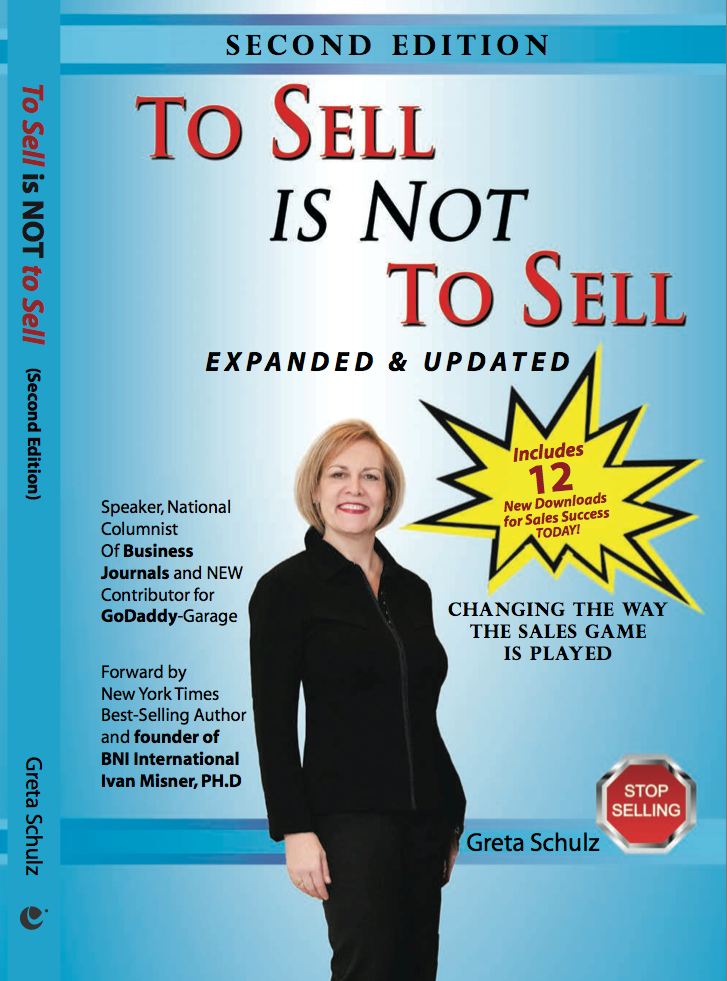
Greta Schulz is president of Schulz Business SELLutions in West Palm Beach, FL. She is the author of "To Sell is Not to Sell" and a columnist for business journals around the country. Greta does corporate training for Fortune 1000 companies and she has an on-line training course for entrepreneurs.

Click here to share this post.

letting the presentation get in the way of the sale

by Admin 16. July 2011 05:52

Letting the presentation get in the way of the Sale

Salespeople devote tremendous amounts of time and

energy in creating compelling presentations. The problem

is, most of this is more impressive to you and your company then the prospect.


If you are a salesperson I can guarantee you are not happy with this article so far. And I bet as a manager or executive, you are scratching your head. Better yet I bet you’re saying, well in some businesses that’s true but in ours, the better our presentation, the better our chance of getting the business….wrong!


Presentations are certainly important in some aspects. Some sort of demonstration of the usage of your product or service is imperative at some point. The problem is in most of our organizations we put so much time and energy into creating a way to tell the prospect why they should buy our product, we often forget to find out why they would. The presentation of our best “features and benefits” is an assumption that what we perceive as our real assets may mean nothing to them! (remember what happens when we assume!)


What’s more, your competitors are doing the exact same thing –giving the same kind of presentations and making the same claims. If you are saying to yourself right now, “well Greta’s right but we’re different and our competitors can’t claim they do what we do” then answer me this, if you are so unique and your presentation is so compelling then why aren’t you closing every deal? Better yet, if it’s that good, fire all of your sales people and just send you presentations to every decision maker in town!


. The old adage of sales was, cold call someone and browbeat them to get the appointment. On the appointment ask a few questions but then get right down to your presentation. Once they see that, they’ll be sold. Trial close or send them a proposal and wait. And how’s that workin’ for ya?


So what needs to be done to make your presentations great? All of the pre-work before you present anything. And maybe after the pre-work you will decide not to present at all. Really.


Here are some very important things to do when selling. First, stop selling! What? Yes that’s right. What I mean by that is the old adage I talked about earlier is typically what we see. Stop that now.

Begin with prospecting through referrals. Cold calling is typically not your best source for good prospects. Networking and referrals are the #1 way to get to the right person and get there quicker.

When you do get someone on the phone begin with the end in mind. Let them know what you do and why you are calling them. Do some research ahead of time so you will be able to develop good questions. Let them know If at the end of your conversation it makes sense to get together then you can set that up, but if it doesn’t that’s ok too and you can end the call there.


If you get an appointment go into the appointment armed with your research on the organization and some thought provoking big-picture questions that you have prepared.

A pen and pad is all you will need here. After asking those questions and really learning about their issues, summarize those to make sure you have understood them, have a discussion upfront about the investment it might take to solve the issues they have and if you can present a viable solution, what would happen at that point.


Here is where you can present but only present the solutions to the issues they have, not everything that you do. People are “selfish”. I don’t mean that negatively but they just look inwardly first at how they will be affected with this solution. If there is some wonderful feature that isn’t necessarily wonderful to them, don’t present it. The more you present, the more they have to go back and think about how they might use it. There will begin your long selling cycle scenario.


So spend more time in preparing for each call and do the real work at the beginning. Don’t depend on some great “dog and pony show” presentation to do the work for you. Most people know who they will choose before they even see the presentations. Make your best impression from the great questions you ask, not your company boasting.


Click here to share this post.

Tags:

CEO's | goals | sales calls | sales tips | sales, selling, on-line sales | sales managers

Telling isn't Selling

by Admin 4. July 2011 06:34

Jim arrived at the office of Bob Simmons, President of the ABC tool and Dye Company early so he could sit in the parking lot and review in his head what he wanted to say. Jim practiced each step of his presentation in his head and exactly what he wanted to say and how he wanted to say it. He knew that his power point slides were perfectly in order and were just want he needed to land this account. He knew what this company needed because he has called on other companies like this and helped them just like he can help this one. Jim took a deep breath and walked into the building, “I’ve got this one down” he thought and proceeded in the door.


Once the pleasantries were over Jim got right down to business. “Mr. Simmons, I have been with my company for the past 3 years and our company has been in business for over 50 years. We are the leader in our industry and have worked with lots of companies like yours and have been able to meet the needs that you have”.


“Well, that’s why I agreed to meet with you, Jim. We do have a need for a product like yours and this might be a good fit” stated Bob Simmons.


“I’m glad you did” Jim said proudly. “Our product line has the best reputation for least failures on the job therefore downtime is at the lowest in the industry which will keep you up and running more efficiently”.


“Great Jim, but our service department isn’t sure if they can retrofit your model into our existing equipment”.


“Oh I wouldn’t worry about that we do it all of the time and with companies who have bigger problems then yours. As a matter of fact I brought a power-point presentation that I believe will help you understand why we’re number one in the industry”.


After the presentation, Mr. Simmons said, “Thanks for the presentation Jim but I am still a little concerned about our existing equipment and the retrofit we’ll need to do. We can’t afford any downtime with the change or production could be compromised”.


“Mr. Simmons, I understand that is a concern but we do this all of the time and don’t worry we can handle it.” 


Fifteen minutes later Jim said goodbye to Mr. Simmons and promised him a proposal in a few days. After he left, Mr. Simmons buzzed his assistant and said when that proposal comes in just round file it.


What happened? Jim ignored the real issue that Mr. Simmons wanted addressed and kept telling him what he felt was important. Guess what? No one cares what you think is important, only as it applies to them. Jim missed lots of opportunity to really deeply understand what his prospects issues were and assure him that not only he could solve the problem but help Mr. Simmons understand how.


Click here to share this post.

Tags:

CEO's | goals | sales calls | sales, selling, on-line sales

Common CEO Questions on Sales

by Admin 25. June 2011 08:32


I thought I would write about the most common questions I get from Presidents and CEO’s around the country about their sales organizations. It doesn’t matter the industry, the time of year or the economic outlook, these are pretty

Common CEO Questions


I thought I would write about the most common questions I get from Presidents and CEO’s around the country about their sales organizations. It doesn’t matter the industry, the time of year or the economic outlook, these are pretty consistent.


1)      Why don’t our sales people prospect more as opposed to waiting for business to come in?

a)      Human nature is to take the path of least resistance. If enough business for them-and this might be a completely different number then for you and your goals- is walking in the door or calling on the phone, why should they prospect? Being reactive is a whole lot easier then being proactive so if you haven’t made those activity goals very clear then why should they?

Revenue goals are important but activity goals are a whole lot more important. Yep, you read this right, more important. When someone is consistency meeting their activity goals then you have the ability to track #1, are they committed to what you have asked them to do (this is huge), #2 you can help them on what they are actually saying and doing in front of  a prospect to improve their closing ratio. Without knowing the amount of calls they are making consistently, this information is completely irrelevant.


2)      How do I motivate my salespeople to do more?


a)      First of all, do more then what? There needs to be goals established for them as mentioned above, for revenue and activity. You may already be doing that and congratulations if you are. They still may be falling short so I have a few questions for you to ponder. 1) Are they making more money then they have previously either in this position or another? If so, they may not be motivated enough to work hard enough to reach a goal you want them to reach. We often take the goals we set for them last year (and the year before and the year before) and hike that number up 10% or 15%. That may be your goal, but if it isn’t necessarily theirs and if they don’t see a need to reach so high, you could be in some trouble. They can be motivated to reach that number, but you better have that discussion with them not for them. 2) If your salespeople don’t reach goal (whether revenue or activity) what is the consequence? Salespeople -actually all of us-are just big kids. They need what is expected of them to be clear and laid out, they need to know the benefit of reaching and exceeding those expectations and the consequences if they don’t. Be careful not to just assume that if you tell them the goals and leave them alone they will get there. They might but if they don’t, wouldn’t you rather try to help them rather then having a revolving door of salespeople through your organization?   


3)      I can talk to a local business person about our product/service and sell it and I’m not even a salesperson? Why can’t they?

a) I don’t have enough information to answer that so I will have to make a few assumptions. As the owner (president ,CEO) of an organization a conversation you have with a colleague will be different then a sales person has because you aren’t selling anything. You are more often then not, having a conversation about some other topic as well, the local state of business, the economy, politics, take your pick, but there is a much higher level of conversation happening so it doesn’t feel like a sale. There are other factors as well. Maybe you are someone of stature or clout in the community and people look at you as an equal, a partner, maybe even someone that can help them down the road. So shouldn’t your salespeople be seen different then you? Actually, the answer is no. Every day we teach people how to treat us. If we are acting like a salesperson, they will be treated like one. You don’t act like one. So the key here is you need to get your salespeople to act as an equal, a partner not a person trying to “pitch” something. When they accomplish that, they will be able to sell like you do.


consistent.


1)      Why don’t our sales people prospect more as opposed to waiting for business to come in?

a)      Human nature is to take the path of least resistance. If enough business for them-and this might be a completely different number then for you and your goals- is walking in the door or calling on the phone, why should they prospect? Being reactive is a whole lot easier then being proactive so if you haven’t made those activity goals very clear then why should they?

Revenue goals are important but activity goals are a whole lot more important. Yep, you read this right, more important. When someone is consistency meeting their activity goals then you have the ability to track #1, are they committed to what you have asked them to do (this is huge), #2 you can help them on what they are actually saying and doing in front of  a prospect to improve their closing ratio. Without knowing the amount of calls they are making consistently, this information is completely irrelevant.


2)      How do I motivate my salespeople to do more?


a)      First of all, do more then what? There needs to be goals established for them as mentioned above, for revenue and activity. You may already be doing that and congratulations if you are. They still may be falling short so I have a few questions for you to ponder. 1) Are they making more money then they have previously either in this position or another? If so, they may not be motivated enough to work hard enough to reach a goal you want them to reach. We often take the goals we set for them last year (and the year before and the year before) and hike that number up 10% or 15%. That may be your goal, but if it isn’t necessarily theirs and if they don’t see a need to reach so high, you could be in some trouble. They can be motivated to reach that number, but you better have that discussion with them not for them. 2) If your salespeople don’t reach goal (whether revenue or activity) what is the consequence? Salespeople -actually all of us-are just big kids. They need what is expected of them to be clear and laid out, they need to know the benefit of reaching and exceeding those expectations and the consequences if they don’t. Be careful not to just assume that if you tell them the goals and leave them alone they will get there. They might but if they don’t, wouldn’t you rather try to help them rather then having a revolving door of salespeople through your organization?   


3)      I can talk to a local business person about our product/service and sell it and I’m not even a salesperson? Why can’t they?

a) I don’t have enough information to answer that so I will have to make a few assumptions. As the owner (president ,CEO) of an organization a conversation you have with a colleague will be different then a sales person has because you aren’t selling anything. You are more often then not, having a conversation about some other topic as well, the local state of business, the economy, politics, take your pick, but there is a much higher level of conversation happening so it doesn’t feel like a sale. There are other factors as well. Maybe you are someone of stature or clout in the community and people look at you as an equal, a partner, maybe even someone that can help them down the road. So shouldn’t your salespeople be seen different then you? Actually, the answer is no. Every day we teach people how to treat us. If we are acting like a salesperson, they will be treated like one. You don’t act like one. So the key here is you need to get your salespeople to act as an equal, a partner not a person trying to “pitch” something. When they accomplish that, they will be able to sell like you do.


Click here to share this post.

Tags:

CEO's | goals | sales calls | sales tips | sales, selling, on-line sales