



The paperclips didn't need a sales pitch. Neither do your clients.

SELLutions

Employee Motivation

by Admin 1. March 2012 08:11
I often get questions about motivating employees. My overall belief is, "you can’t motivate anyone to do anything, just give them an opportunity to motive themselves". That being said what do you do to give them an opportunity to motivate themselves?

As a business owner, you don't want employees who are only motivated to perform well so they can "win a prize". You want employees who are motivated to perform well every day, no matter what carrot you're dangling in front of them.

What you really need is a team of employees who are emotionally invested in your company. A feeling of ownership. To cultivate that, you need family support. No amount of job awards can out-influence the home front. You can offer praise and gifts left and right, but you won't see much improvement in your employees performance if she goes home to a partner who says, "How much longer are you going to work there if you’re not happy?"

Please don’t mis-understand, I'm not suggesting that your employees need to have a love affair at work. It's just that the men and women your employees go home to at night that have the power to motivate (or de-motivate) far better and faster than you could.

Here's the key to winning over an employee's family: Start from day one. The first thing your newly hired staff member will likely hear from a significant other when he gets home is, "How was your first day?" If he spent it mostly filling out a three-foot stack of forms, ordering his own business cards and eating lunch alone, he might rightfully answer: "Lousy." His better half will quickly get down on your company, too, and hardly encourage the top-notch performance you want to see.

There's a full-proof way to get employees, and their loved ones at home, excited about working for your company from day one. First, really make them feel welcome. We want to be liked and accepted. Start a new employee program at your company. Have all employees (depending on the size of your organization) make a point through out that first day to stop and say hello to the new employee and welcome them. I also really like the idea of a sign at the front door that says, “Welcome Jane Smith We are glad you are here”. Additionally a welcome cake at lunch for all to stop by and enjoy is a great idea as well.

So, what happens if your new recruit comes home with a great story about his amazing first day? His better half will realize the opportunity he has—she'll become the ultimate motivator, rather than detractor.

Keep in mind, there are many definitions of family. Your new employee may be single (or soon to be). It's your mission to find out who makes up his or her support system and give accordingly. Perhaps it's a gift card for a night out with pals or a matinee with mom.

When your employees hear daily words of encouragement from their closest confidantes like, "I can't believe how lucky you are to be working for that guy!" their motivation rises to levels you've never tapped before. It's worked for me in all of my companies. And even if you can't afford more than a home-baked cake or thank-you card, giving your new employees a best first day ever is the key to keeping them motivated for years to come.

There are so many statistics about how much better and more productive your employees are when they feel good about working for you. We spend lots of money to recruit, and hire a new team member. Lets not forget their value after they are hired.

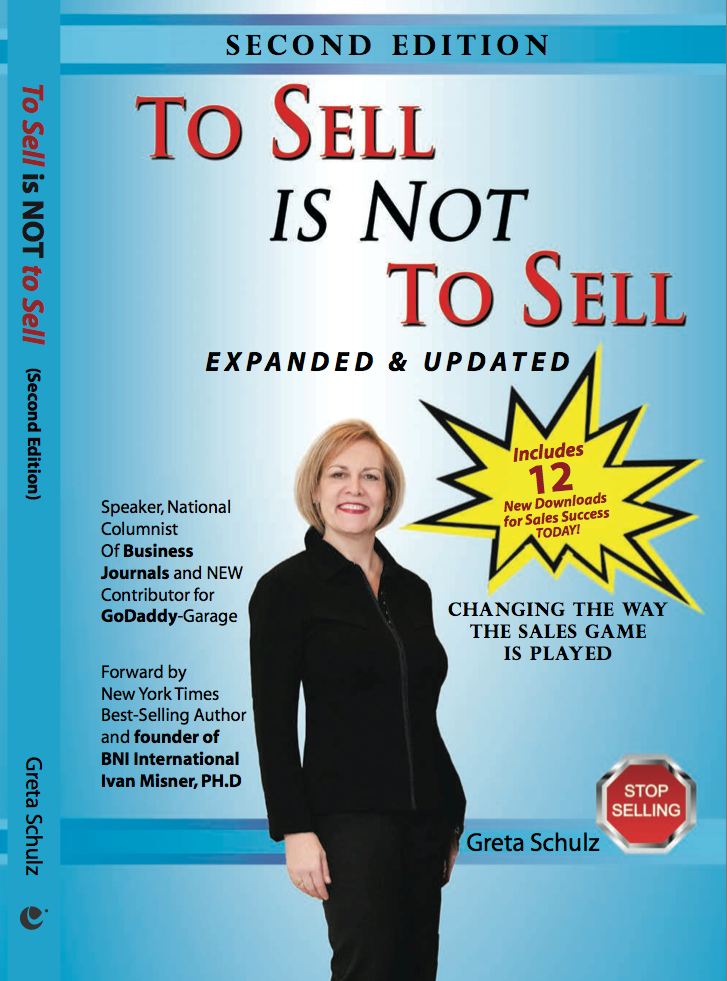
Greta Schulz is president of Schulz Business SELLutions in West Palm Beach, FL. She is the author of "To Sell is Not to Sell" and a columnist for business journals around the country. Greta does corporate training for Fortune 1000 companies and she has an on-line training course for entrepreneurs.

Click here to share this post.

Are You Selling a Book or a Movie?

by Admin 17. February 2012 07:31
"I’m going to try my best to do a great benefits statement so the customers know exactly what we do."

We put so much time and energy into coming up with this big introduction/benefit statement, but, honestly, it’s not as important as any of the other things that we do. This thought is on the mind of most salespeople. They feel that they have to have some great, two-sentence explanation of what they do, and that will help sell it.

Now, it is important to summarize what you do, but that is not what sells. Let me illustrate this point. Think about the last time you read a book, and then saw the movie. Which is typically better? Well, almost everyone I talk to says the book is better. Why is that?

When you read a book, you have the ability to create what the scene looks like, what the characters look like, even the voices and sounds therefore the story becomes yours. When you put something in your own brain, you are able to create what it looks like, and what it sounds like, and what it feels like to you. You attach more directly to the story because it becomes your interpretation of the events as opposed to some producer and director’s interpretation. This is the same reason why telling someone what you do and the “features and benefits” of your product or service is much less powerful then asking great questions and getting them to see how it can help through their own eyes.

When you tell someone why they should work with you, what the benefits are, what the advantages are, those are your interpretations of the benefits or the advantages that you offer. When you ask really good questions to get people to think about what is important to them, it is their idea.

Ask if they had success in a particular area, or how you can change things. It is this kind of thought-provoking questions that allows a prospect to see the advantage, on their own, your product is supposed to bring. So, asking questions is really much more important than coming up with an important benefit statement.

There are a couple different types of questions. Big picture questions are thought-provoking questions that get the customer talking about the overall situation. For example, talk about the goals they set for the organization, and where they are along the line of those goals. “Right now, it is (plug in the date) and if it were one year from today and you were to look back and say, it has been a very successful year, what would have to have happened?”

Another might be: “What are the things that you fear the most over the next 12 months, and what are you doing to avoid them?”

The key is to ask big picture questions and get people to think. The successful questions ask people to think about the answer and put themselves in that place before they do. Big picture questions are typically used at the beginning of the conversation to get a prospect to open up sooner. You listen to the answers carefully and move through the conversation successfully.

The second type of question are what I call advantage questions. They come directly from what you believe are the advantages of your product or service. For example, if you sell advertising in a very high end magazine, you might say “Talk to me about how you get in front of high-income individuals now.” Then a follow-up question like “If you had the ability to get in front of more of them, what would you say?” Again it forces them to think about not only being in front of potential clients that they’re trying to get in front of, but it has them think about what the message would be. It begins to develop where you’re going to go with your recommendations or proposal in the end.

So, rather than you telling them what they can do with your product or service, this allows them to come up with their own picture of how they might use your product.

Remember, when you go to the movies, it is purely the director and the producer’s interpretation. When you read a book, it’s your interpretation of those words, and you have the ability to create your own picture. It’s much more effective when it’s yours.

Greta Schulz is president of Schulz Business SELLutions in West Palm Beach, FL. She is the author of "To Sell is Not to Sell" and a columnist for business journals around the country. Greta does corporate training for Fortune 1000 companies and she has an on-line training course for entrepreneurs.

Click here to share this post.

Common CEO Questions

by Admin 13. February 2012 04:20
I thought I would write about the most common questions I get from Presidents and CEOs around the country about their sales organizations. It doesn’t matter the industry, the time of year or the economic outlook, these are pretty consistent.


Q1) Why don’t our sales people prospect more as opposed to waiting for business to come in?

a) Human nature is to take the path of least resistance. If enough business for them-and this might be a completely different number then for you and your goals-is walking in the door or calling on the phone, why should they prospect? Being reactive is a whole lot easier then being proactive so if you haven’t made those activity goals very clear then why should they?

Revenue goals are important but activity goals are a whole lot more important. Yep, you read this right, more important and there's two reasons why. When someone is consistently meeting their activity goals then you have the ability to track (that's reason number one), are they committed to what you have asked them to do? This is huge. Reason number two is you can help them on what they are actually saying and doing in front of  a prospect to improve their closing ratio. Without knowing the amount of calls they are making consistently, this information is completely irrelevant.


Q2) How do I motivate my salespeople to do more?

a) First of all, do more than what?

There needs to be goals established for them as mentioned above, for revenue and activity. You may already be doing that and congratulations if you are. They still may be falling short so I have a few questions for you to ponder.

1) Are they making more money then they have previously either in this position or another? If so, they may not be motivated enough to work hard enough to reach a goal you want them to reach. We often take the goals we set for them last year (and the year before and the year before) and hike that number up 10% or 15%. That may be your goal, but if it isn’t necessarily theirs and if they don’t see a need to reach so high, you could be in some trouble. They can be motivated to reach that number, but you better have that discussion with them not for them.

2) If your salespeople don’t reach your goal (whether revenue or activity) what is the consequence? Salespeople, actually all of us, are just big kids. They need what is expected of them to be clear and laid out, they need to know the benefit of reaching and exceeding those expectations and the consequences if they don’t. Be careful not to just assume that if you tell them the goals and leave them alone they will get there. They might but if they don’t, wouldn’t you rather try to help them rather then having a revolving door of salespeople through your organization?


Q3) I can talk to a local business person about our product/service and sell it and I’m not even a salesperson? Why can’t they?

a) I don’t have enough information to answer that so I will have to make a few assumptions. As the owner (President , CEO) of an organization a conversation you have with a colleague will be different then a sales person has because you aren’t selling anything. You are more often then not, having a conversation about some other topic as well, the local state of business, the economy, politics, take your pick, but there is a much higher level of conversation happening so it doesn’t feel like a sale.

There are other factors as well. Maybe you are someone of stature or clout in the community and people look at you as an equal, a partner, maybe even someone that can help them down the road. So shouldn’t your salespeople be seen different then you?

Actually, the answer is no. Every day we teach people how to treat us. If we are acting like a salesperson, they will be treated like one. You don’t act like one. So the key here is you need to get your salespeople to act as an equal, a partner, not a person trying to "pitch" something. When they accomplish that, they will be able to sell like you do.

Greta Schulz is president of Schulz Business SELLutions in West Palm Beach, FL. She is the author of "To Sell is Not to Sell" and a columnist for business journals around the country. Greta does corporate training for Fortune 1000 companies and she has an on-line training course for entrepreneurs.

Click here to share this post.

Motivated Employees?

by Admin 9. November 2011 10:23


I often get questions about motivating employees. My overall belief is, “you can’t motivate anyone to do anything, just give them an opportunity to motive themselves”. That being said what do you do to give them an opportunity to motivate themselves?

As a business owner, you don't want employees who are only motivated to perform well so they can win a ‘prize”. You want employees who are motivated to perform well every day, no matter what carrot you're dangling in front of them. What you really need is a team of employees who are emotionally invested in your company. A feeling of ownership. To cultivate that, you need family support.

No amount of job awards can out-influence the home front. You can offer praise and gifts left and right, but you won't see much improvement in your employees performance if she goes home to a partner who says, "How much longer are you going to work there if you’re not happy?"

Please don’t mis-understand, I'm not suggesting that your employees need to have a love affair at work. It's just that the men and women your employees go home to at night that have the power to motivate (or de-motivate) far better and faster than you could.

Here's the key to winning over an employee's family: Start from day one. The first thing your newly hired staff member will likely hear from a significant other when he gets home is, "How was your first day?" If he spent it mostly filling out a three-foot stack of forms, ordering his own business cards and eating lunch alone, he might rightfully answer: "Lousy." His better half will quickly get down on your company, too, and hardly encourage the top-notch performance you want to see.

There's a full-proof way to get employees—and their loved ones at home—excited about working for your company from day one. First, really make them feel welcome. We want to be liked and accepted. Start a new employee program at your company. Have all employees (depending on the size of your organization) make a point through out that first day to stop and say hello to the new employee and welcome them. I also really like the idea of a sign at the front door that says, “welcome Jane Smith We are glad you are here”. Additionally a welcome cake at lunch for all to stop by and enjoy is a great idea as well.

So, what happens if your new recruit comes home with a great story about his amazing first day? His better half will realize the opportunity he has—and she'll become the ultimate motivator, rather than detractor.

Keep in mind, there are many definitions of family. Your new employee may be single (or soon to be). It's your mission to find out who makes up his or her support system and give accordingly—perhaps a gift card for a night out with pals or a matinee with Mom.

When your employees hear daily words of encouragement from their closest confidantes like, "I can't believe how lucky you are to be working for that guy!" their motivation rises to levels you've never tapped before. It's worked for me in all of my companies. And even if you can't afford more than a home-baked cake or thank-you card, giving your new employees a best first day ever is the key to keeping them motivated for years to come.

There are so many statistics about when your employees feel good about working for you, the better and more productive employees they are. We spend lots of money to recruit, and hire a new team member. Lets not forget their value after they are hired.


Click here to share this post.

10 Ideals Athletes and Business People Share. Guest Post

by Admin 21. April 2011 07:00
Patti Dranz is a 4 time State of Florida High School Diving Champion, a feat not accomplished in 51 years!  She was at Westminster Academy in Ft. Lauderdale and now swims for the South Carolina Gamecocks.

She was asked what are 10 things she learned in this championship process:

*God directs where He wants us to be.  We just  have to be there for the ride.

*Be willing and open to try new ideas even if initially it's not what you think you want to do.

 God knows best.  Believe it.

*It was an uphill journey.  One that required much patience.

*Persistence.  Anything worth having is definitely worth working for.

*Attitude.  Attitude is a major part of everything.

*Don't let failure be final.  Nobody likes failing at anything.  Get back up and do it again.  Own it.

*Diving is as much a mental battle as it is a physical one.  Skill can only take you so far.

*Friends and encouragers definitely help along the way.

*Humility is key.

*Give credit where credit is due.  All talents and abilities are gifts from God and need to be used all for His glory.

Wow!  These are excellent points that apply not only to diving but all areas of life!

Live Passionately!

This post was shared by John Barber who writes the Barber Financial Minute, a weekly business strategy brief for entrepreneurs and business owners.  For more info check out: www.barbarfinancial.com

This post appeared in the SELLutions monthly information guide and newsletter. To get sales training tips, tools and tested and tried sales techniques click here to sign up today. http://www.schulzbusiness.com/default.aspx#newsletter Click here to share this post.

Tag cloud