



(561) 745-8892Info@SchulzBusiness.com
FREE RESOURCES
SchulzBusiness SELLutions
The paperclips didn't need a sales pitch. Neither do your clients.

SELLutions

In Sales No One Cares

by GSchulz 15. May 2012 12:56
    Tim arrived early at the office of Rob Simon, president of the ABC Tool & Dye Intl., so he could sit in the parking lot and review what he wanted to say. Tim practiced each step of his presentation in his head, exactly what he wanted to say and how he wanted to say it. He knew that his PowerPoint slides were perfectly in order and were just what he needed to land this account. He knew what this company needed, because he has called on other companies like this and helped them just like he can help this one. Tim took a deep breath and walked into the building. "I've got this one down," he thought, and proceeded in the door. Once the pleasantries were over, Tim got right down to business. "Mr. Simon, I have been with my company for the past five years, and our company has been in business for over 50 years. We are the leader in our industry and have worked with lots of companies like yours and have been able to meet the needs that you have." "Well, that's why I agreed to meet with you, Tim," stated Mr. Simon. "We do have a need for a product like yours, and this might be a good fit." "I'm glad you did," Tim said proudly. "Our product line has the best reputation for least failures on the job, therefore downtime is at the lowest in the industry, which will keep you up and running more efficiently." "Great, Tim, but our service department isn't sure if they can retrofit your model into our existing equipment," Mr. Simon said. "Oh, I wouldn't worry about that, we do it all the time and with companies that have bigger problems than yours. As a matter of fact, I brought a PowerPoint presentation that I believe will help you understand why we're No. 1 in the industry." After the presentation, Mr. Simon said, "Thanks for the presentation, Tim, but I am still a little concerned about our existing equipment and the retrofit we'll need to do. We can't afford any downtime with the change, or production could be compromised." "Mr. Simon, I understand that is a concern, but we do this all the time. Don't worry, we can handle it," Tim said. Fifteen minutes later, Tim said goodbye to Mr. Simon and promised him a proposal in a few days. After Tim left, Mr. Simon buzzed his assistant and said when that proposal comes in, to just "round file" it. What happened? Tim ignored the real issue that Mr. Simon wanted addressed and kept telling him what he felt was important. Guess what? No one cares what you think is important, only as it applies to them. Tim missed lots of opportunity to really deeply understand what his prospect's issues were and assure him that not only could he solve the problem, but help Mr. Simon understand how. The result? Tim may very well have the best product for Mr. Simon, but Mr. Simon didn't see it that way. When a prospect gives you a hint of a need, address that need by asking really good, pointed questions, for example: §  Tell me more about the retrofit concern? §  Have you had that issue in the past in looking to change products? §  What happened? §  What did you do to address it at that time? §  How did it effect production and at what cost? These types of questions would not only have given Tim a real insight to the issue, it would have also given Mr. Simon confidence that Tim knew and could address HIS issue. Quick wrap-up: §  Stop telling about how great you and your company are (no one cares). §  Ask what some of the prospect's concerns are and then dig deeper to truly understand the issue. §  Don't be so quick with a solution, even if it is correct; you haven't earned the right so early in the process to give one. §  Listening is your best sales tool, not your product knowledge. Greta Schulz is Sales Consultant for Businesses and Entrepreneurs.  For more Sales Training Tips and Tools, please sign up for her SELLutions Caffeine at http://SchulzBusiness.com  or join her new Online Sales Training Course at http://B2bSalesPlayBook.com       Click here to share this post.

Remember the reinforcement to make sales training programs stick

by GSchulz 5. May 2012 06:19
I am writing this at the Atlanta Airport on my way back from meeting with one of my clients.

Last month we offered a sales training program for her staff. She reported that they saw an immediate increase in sales after the program.

She listened in on their calls to see what had changed. To her pleasure they were asking good, open-ended questions. They were taking time to listen to the client’s responses and using their comments to match them with the right products. They were even closing right at the correct time.

She was excited.

Unfortunately, not all of the reps kept it up. Within weeks, some of the rep’s sales had slipped back to their original level. Another listening survey showed the cause. Each of the reps whose sales were down had slipped back into their old ways. It was as if they were on a high during training, and now it was business as us usual.

Surprised? I’m not.

For years these reps had been trained to operate in telling mode. They gave the same pitch to every caller. Now we were asking them to change, and change takes time.

So what do you do? Forget training? No, but you may want to think about the reinforcement that it takes to make a training program stick.

Whether you are offering training for your team or simply taking a training program yourself, recognize that old habits are hard to break.

There must be a reinforcement regimen to turn that training into practice and the practice into habit.

Just like growing a garden, you need to plant the seeds, water them, fertilize them, water them again and again. Then you will start seeing the benefits. Eventually the flowers will all begin to grow, but you need to work hard and have faith, not give up. Then you see the results.

Like anything in life, learning a new skill takes time and change. Change doesn’t happen quickly, and if it does it typically goes away just as fast.

There is no liquid diet out there that really works forever. Don’t expect that with your people.

If we were training 5-year-olds who don’t have bad habits already, they could make the new information stick a lot quicker. That’s why our children can learn a new language or even two much faster then we can.

Unfortunately, 5-year-olds don’t have the rest of the pieces of the business pie. Too bad, because I would love to train for a few hours and then everyone lay down for a little nap time.

Ready? Take our corporate sales training assessment.
Click here to share this post.

The Take-Away

by GSchulz 27. March 2012 10:34
“I really can’t say that what you’ve shown me, Bob, does anything for me,” stated the prospect.

“In fact,” he went on, “your choice of colors is nowhere as extensive as your competitor’s, who was just in here this morning, by the way.”

Bob hated this type of prospect. And for some reason, the past five months had been filled with them. Gosh, thought Bob, this is going to be one of those meetings where he raises the hundred objections and I try to beat them down one after another.  There’s got to be a better way to make a living. “I didn’t know you were looking at anyone else,” responded Bob.

“Well, it’s what I should do. And I’ll tell you this now, right upfront, her prices are extremely favorable.  I doubt you could beat them.”

Here goes, thought Bob, start knocking them down. “Let’s talk about the colors; our colors are by far the…” Two hours later, Bob crawled out of the office with a signed purchase order. Totally exhausted, he got into his car, called the office and read them the order.

“Good work,” the sales manager responded, “but how come he’s ordering less than before?”

“The competition has got a proposal on the table,” responded Bob, “you wouldn’t believe what I had to do to get what we did.”  With a felling of dread he added, “I’m going back next week to see if I can knock them out.”

Bob was so afraid that he was going to lose the client that he was prepared to do just about anything to keep him. Bob had the guts to spend another two hours butting heads, but he did not have the guts to find out if he really needed to do this.

Taking a sale away, taking yourself out of the running, and then waiting for a response from the prospect/customer takes real guts. This is not a technique for those with weak knees. No one can fault Bob for his dedication to task. And most salespeople and sales managers would agree that in the above story, which happens every day, there was nothing else to do but “gut it out.” But there is something else.

Before Bob launched into meeting every objection, he could have done something very simple. He could have said, “You might not realize what you are telling me; I want to make sure that I have it right. The competition has more colors, the price is good, they were here this morning, I guess it’s over for me. When you gave the order to the salesperson this morning, was she excited?” And then wait for a response from the prospect, no matter how long it takes. In order for this technique to work, your really have to mean it and be prepared to “walk out the door” and not look back. If you cannot do this, this technique will blow up in your face. However, if you are truly prepared to walk away, this technique is incredibly powerful at eliminating objections. There are a multitude of words and gestures that you can use to “take it away” depending on what you are trying to accomplish and with whom.

Customers and prospects alike are famous for stating, in so many words, that the other guy can do better for less. In essence, you want to mirror back to them what they just told you and then state, not ask, “You did place the order.” Then do not speak until you get a response. Either the order has been placed or not. If is has, it probably really is over for you. If it hasn’t, then you deserve to know the reasons why. And when you find out why? You are now learning what you need to do to get the order or keep the order.

Prospects who gave given all the indications of being ready to buy, but who just resist closing, are especially susceptible to having it taken away. “Bill, you have given every indication that you are ready to buy. But for some reason you just aren’t sharing, you keep stopping short. I think I should leave.” Then wait for a response.

MORAL: Take it away ONLY if you are prepared to walk out the door. Once you take it away, wait for a response regardless of how long it takes.

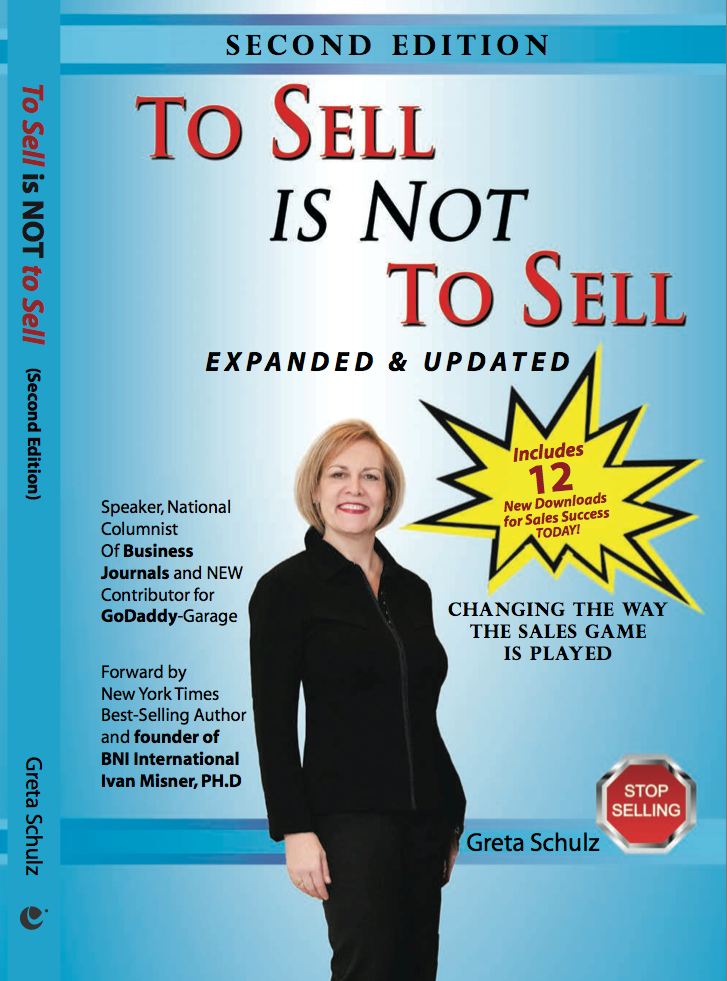
Greta Schulz is president of Schulz Business SELLutions in West Palm Beach, FL. She is the author of "To Sell is Not to Sell" and a columnist for business journals around the country. Greta does corporate training for Fortune 1000 companies and she has an on-line training course for entrepreneurs.

Click here to share this post.

Economic Uncertainty... Or Excuse Making?

by GSchulz 21. March 2012 08:40
Are you still nervous about the economy?

Are the upcoming elections causing you to tighten the ole’ belt?

Have you come to the conclusion that we are all in the dark about when it will actually be over?

This is not a time for anxiety, but a time to be realistic and acknowledge that tough times lay ahead. Adjustments have to be made in your sales team and in the way they approach sales. If you don’t do it now, the competition certainly will. During the past, in our economic “high,” I’m sure your sales team and numbers grew exponentially. But seeing as though your longer term salespeople had been used to sales falling in their lap, have they fully adjusted to the new reality or are they still using the economy as an excuse for not making those adjustments? With the recession still lingering, what should we expect from our “order takers” of the past? Probably not a whole bunch!

Right now, the weak part of your company is probably still your sales team. Companies are becoming aggravated very quickly when their salespeople aren’t selling for reasons you think are out of their control.  Sales people, too, are getting discouraged when they don’t close sales, not knowing that their sales in the previous bull market were simply coming to them with little to no work involved. A lot of companies wait until they’re desperate, then layoffs and cost cutting will start. The smart companies know that they should evaluate their sales force now, finding out who really has effective selling skills to utilize in the slump that we’re about to face.

When assessing your team, remember to ask yourself the following questions:

What are the necessary elements for selling in this economy?
Who has these elements?
Who does not have these skills and should we replace them?
Who should we replace them with?

Don’t fall victim your salesperson’s beliefs that “people are spending less” and “it’s an election year.”  Excuses, excuses, excuses!

Don’t believe that just because they’ve done well in the past, they may be right. If they’re not strong enough to make it through tough times, they probably don’t belong on your team! You must ask yourself, “have they really been selling or were they just order takers that got lucky?” If you’re not sure, you have to evaluate their skills! Go on a sales call with them and see how they do in the “real world.” Another option is having them take an assessment that shows the skills they truly have… And the ones they don’t. Masked weaknesses show themselves when you least expect it.

Hold your ground and act as though the economy is flourishing! I know you think I’m crazy, but hear me out. If you remember that the economy is cyclical, you won’t fall prey to the negative thoughts about our current situation. When things are bad, nothing should change. Then you’re not falling into a slump, but simply continuing to work hard until things come back around. (Which they always do!) If you turn “fat and happy,” you’ll never make it through. Neither our mortgage lender, our bank, nor the power company will accept the excuse of the economy for non-payment. Why should we? Should we make some adjustments? Possibly, but now the real sales professionals will shine through the excuse makers. You will see real creativity and out of the box thinking like never before. Now you will really see what separates the men... well, you know the cliché.

Greta Schulz is president of Schulz Business SELLutions in West Palm Beach, FL. She is the author of "To Sell is Not to Sell" and a columnist for business journals around the country. Greta does corporate training for Fortune 1000 companies and she has an on-line training course for entrepreneurs.

Click here to share this post.

Are You Selling a Book or a Movie?

by Admin 17. February 2012 07:31
"I’m going to try my best to do a great benefits statement so the customers know exactly what we do."

We put so much time and energy into coming up with this big introduction/benefit statement, but, honestly, it’s not as important as any of the other things that we do. This thought is on the mind of most salespeople. They feel that they have to have some great, two-sentence explanation of what they do, and that will help sell it.

Now, it is important to summarize what you do, but that is not what sells. Let me illustrate this point. Think about the last time you read a book, and then saw the movie. Which is typically better? Well, almost everyone I talk to says the book is better. Why is that?

When you read a book, you have the ability to create what the scene looks like, what the characters look like, even the voices and sounds therefore the story becomes yours. When you put something in your own brain, you are able to create what it looks like, and what it sounds like, and what it feels like to you. You attach more directly to the story because it becomes your interpretation of the events as opposed to some producer and director’s interpretation. This is the same reason why telling someone what you do and the “features and benefits” of your product or service is much less powerful then asking great questions and getting them to see how it can help through their own eyes.

When you tell someone why they should work with you, what the benefits are, what the advantages are, those are your interpretations of the benefits or the advantages that you offer. When you ask really good questions to get people to think about what is important to them, it is their idea.

Ask if they had success in a particular area, or how you can change things. It is this kind of thought-provoking questions that allows a prospect to see the advantage, on their own, your product is supposed to bring. So, asking questions is really much more important than coming up with an important benefit statement.

There are a couple different types of questions. Big picture questions are thought-provoking questions that get the customer talking about the overall situation. For example, talk about the goals they set for the organization, and where they are along the line of those goals. “Right now, it is (plug in the date) and if it were one year from today and you were to look back and say, it has been a very successful year, what would have to have happened?”

Another might be: “What are the things that you fear the most over the next 12 months, and what are you doing to avoid them?”

The key is to ask big picture questions and get people to think. The successful questions ask people to think about the answer and put themselves in that place before they do. Big picture questions are typically used at the beginning of the conversation to get a prospect to open up sooner. You listen to the answers carefully and move through the conversation successfully.

The second type of question are what I call advantage questions. They come directly from what you believe are the advantages of your product or service. For example, if you sell advertising in a very high end magazine, you might say “Talk to me about how you get in front of high-income individuals now.” Then a follow-up question like “If you had the ability to get in front of more of them, what would you say?” Again it forces them to think about not only being in front of potential clients that they’re trying to get in front of, but it has them think about what the message would be. It begins to develop where you’re going to go with your recommendations or proposal in the end.

So, rather than you telling them what they can do with your product or service, this allows them to come up with their own picture of how they might use your product.

Remember, when you go to the movies, it is purely the director and the producer’s interpretation. When you read a book, it’s your interpretation of those words, and you have the ability to create your own picture. It’s much more effective when it’s yours.

Greta Schulz is president of Schulz Business SELLutions in West Palm Beach, FL. She is the author of "To Sell is Not to Sell" and a columnist for business journals around the country. Greta does corporate training for Fortune 1000 companies and she has an on-line training course for entrepreneurs.

Click here to share this post.